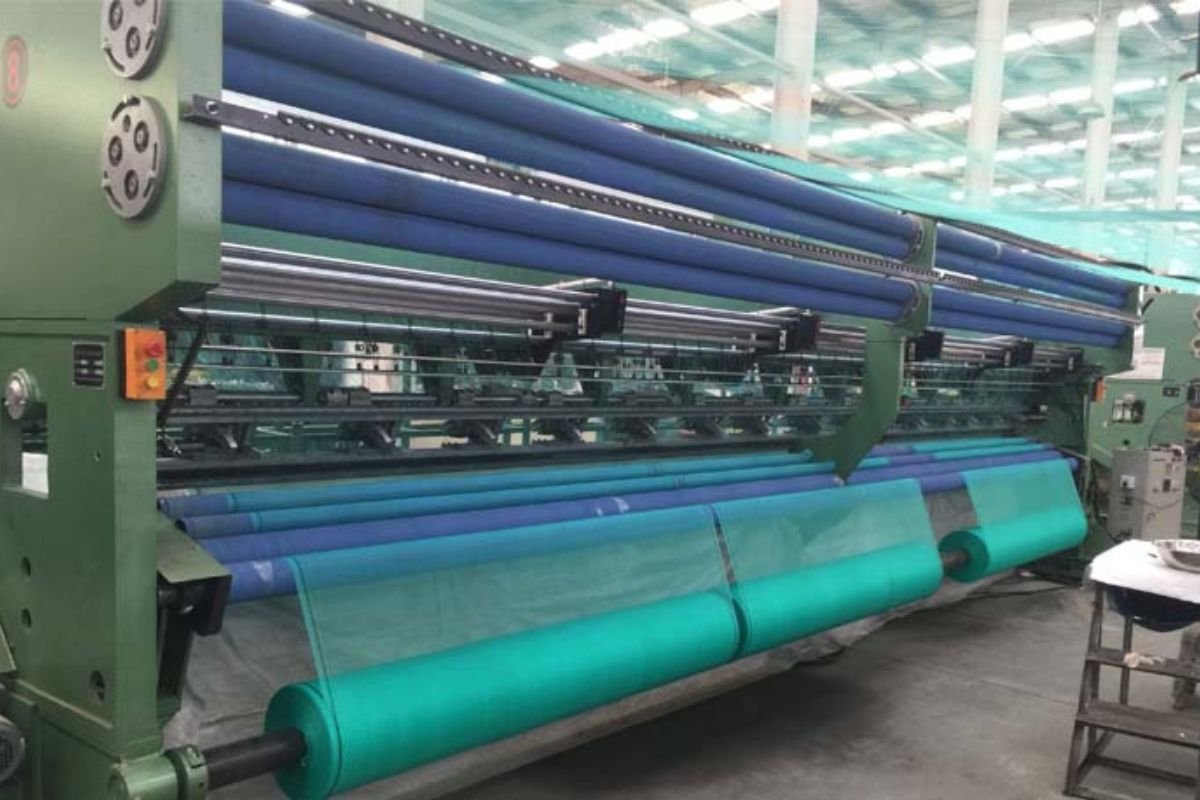
HDPE shade nets are used everywhere in the UAE parking areas, construction sites, agriculture, gardens, warehouses, outdoor commercial spaces, and villa shading. But very few buyers actually understand how these nets are made and why certain types last longer, perform better, or offer stronger UV protection.
This guide explains the entire HDPE knitted shade net manufacturing process, covering:
- Monofilament vs tape yarn
- Raschel knitting
- UV stabilisation
- Density control
- Colour production
- Final quality checks
If you offer shade net installation or supply across the UAE, understanding this process helps you choose higher-quality products and avoid weak or short-life alternatives.
1. Raw Material Selection: 100% Virgin HDPE
The manufacturing process starts with 100% virgin High-Density Polyethylene (HDPE), not recycled material.
Virgin HDPE ensures:
- Stronger tensile strength
- Longer lifespan in the UAE heat
- Better UV stability
- Crack resistance
- Consistent colour and density
Brands like Dunet Shade Nets, supplied via Exclusive Tarps, use virgin HDPE for maximum durability.
2. Extrusion: Converting HDPE Into Filaments
Once HDPE granules are selected, they go through an extrusion process to form the fibres used in knitting.
There are two main extrusion styles:
2.1: Monofilament Extrusion
Monofilament yarns are produced by extruding HDPE into single, round, strong filaments.
Benefits of monofilament yarns:
- Stronger tensile strength
- Longer lifespan (5-7 years in UAE weather)
- Better UV stability
- Ideal for commercial and industrial shade nets
Link to product: Dunet Monofilament Knitted Shade Cloth
2.2: Tape Yarn (Flat Filament) Extrusion
Flat polymer sheets are extruded and then slit into thin “tape-like” yarns.
Benefits:
- More economical
- Flexible
- Ideal for agriculture, nurseries, and temporary shading
- Good airflow
Related products: Dunet Flat Filament Knitted Shade Cloth UL506, Dunet Flat Filament Knitted Shade Cloth SSGB6E
3. UV Stabilisation Treatment
UAE sunlight is extremely harsh, so shading fabrics must be treated with UV stabilisers during production.
UV treatment ensures:
- Colour does not fade
- Fibres do not crack
- The net survives 50°C+ summers
- Long-term durability outdoors
Premium shade nets, such as FR200 Fire-Retardant Netting, combine UV stabilisation with fire resistance.
4. Raschel Knitting: The Core of Shade Net Manufacturing
Most high-quality HDPE shade nets in the UAE are produced using Raschel warp knitting machines.
Why Raschel Knitting Matters?
It controls:
- Shade percentage
- Airflow
- Strength
- Fabric flexibility
- Wind resistance
Raschel Knitting Steps
- Monofilament or tape yarn is fed into the machine.
- Warp and weft structures are knitted together.
- Knitting density determines shade percentage (30% to 95%).
- Fabric rolls are produced in widths of 2m, 3m, 4m, and 6m.
For shade percentage guidance: See the blog How to Choose the Right Shade Percentage in Dubai
5. Heat Setting
To prevent fabric shrinkage, curling, or deformation in extreme temperatures, the knitted fabric goes through heat-setting.
Benefits:
- Dimensional stability
- Smooth finish
- Cleaner edges
- Balanced tension
6. Colour Masterbatch Mixing
HDPE shade nets are usually available in:
- Green
- Black
- Beige / Sand
- Dark Green
- Blue (custom)
- White (greenhouses)
Pigments are mixed during extrusion for long-term colour stability.
For detailed colour performance: Colour Guide: Green, Beige & Black Shade Nets
7. GSM & Density Calibration (Shade % Control)
Manufacturers adjust:
- Yarn thickness
- Yarn spacing
- Knitting pattern
- Stitch density
…to produce different combinations like:
- 120 GSM – 50% shade
- 160 GSM – 70% shade
- 200 GSM – 90% shade
- 230 GSM – 95% shade
Learn more here: GSM vs Shade Percentage Guide
8. Finishing, Rolling & Packaging
The finished shade net is:
- Cut into rolls
- Checked for knitting consistency
- Edge-reinforced
- Packed for shipment
- Tested for tensile strength & UV stability
High-grade options like Dunet Monofilament Knitted Shade Cloth undergo stricter QC standards, ensuring long-term durability.
9. Final Use-Case Classification
Before distribution, shade nets are labelled based on use cases:
Agriculture & Greenhouse
50%-70% | tape yarn or monofilament
Parking & Industrial
90%-95% | monofilament only
Privacy Fencing / Outdoor Walls
85%-95%
See our Shade Net Privacy Fencing
Bird Control
Lightweight | 15mm-40mm mesh
View our Bird Netting
Frequently Asked Questions
What is the difference between monofilament and tape yarn shade nets?
Monofilament nets utilise round, single-strand filaments that are stronger and more durable. Tape yarn utilises flat filaments, which are economical and ideal for agricultural applications.
Why is Raschel knitting used for shade nets?
Raschel knitting offers excellent airflow, controlled shade percentage, strong tear resistance, and balanced tension, making it perfect for UAE conditions.
How long does a high-quality HDPE shade net last in Dubai?
With UV stabilisation and monofilament construction, high-quality nets last 4-7 years depending on exposure.
Why is UV treatment essential?
Without UV stabilisers, HDPE breaks down quickly in the desert sun. UV treatment prevents cracking, fading, and early damage.
What GSM is used for commercial shade nets?
For industrial and parking applications, 200-250 GSM monofilament fabrics are recommended.
Can I customise colour and shade percentage?
Yes, factories adjust shade %, yarn type, density, and colour masterbatch according to the requirement.
Which knitting pattern is best for heavy-wind areas?
A dense Raschel knit with monofilament yarn provides maximum wind resistance and structural strength.
Do tape yarn shade nets last long?
Tape yarn nets are economical but not as durable as monofilament. They are best for temporary or agricultural use.